

17 June 2025
Matthew Bourne’s The Midnight Bell is a hauntingly beautiful, achingly understated portrait of love, lust and longing in the 1930s, inspired by the atmospheric works of the great English novelist, Patrick Hamilton, who also wrote the highly successful stage plays Rope and Gaslight.
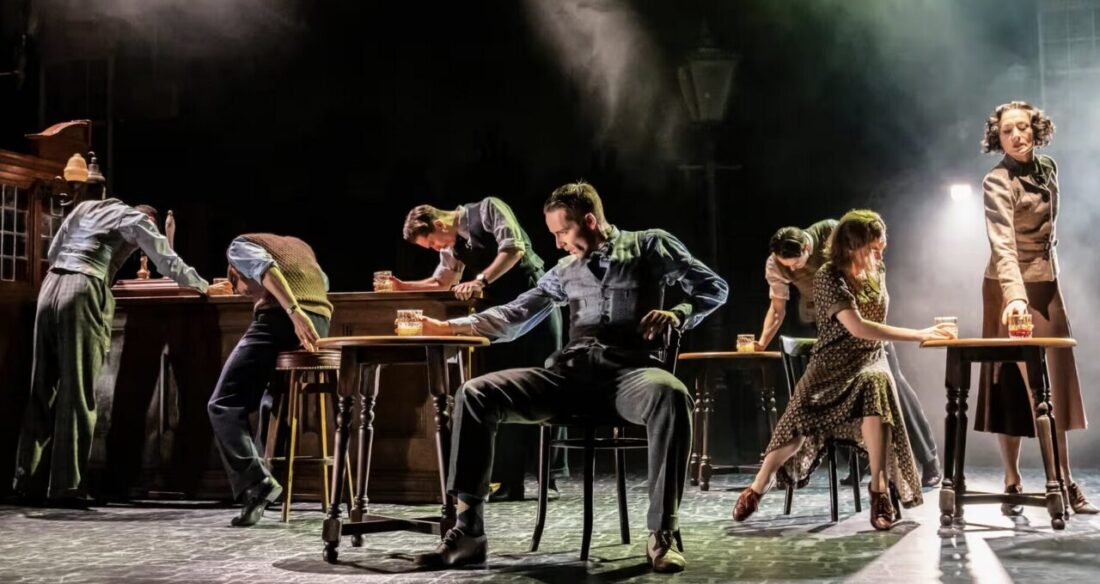
Set in a fog-drenched London, where desire and disillusionment linger in every doorway and backstreet and humiliation is never far away, it centres on the regulars at the dingily-lit London boozer and the habitants of nearby seedy boarding houses… all lonely souls looking for love or sex – and never without a drink in their hands as they dance and couple up as if their lives depended on it.
This is a dance masterpiece – it was nominated for five awards at the 2022 National Dance Awards, with Matthew Bourne winning Best Modern Choreography and Michela Meazza Outstanding Female Modern Performance – but this latest version is even better than at its premiere, it’s slicker, sleeker, surer footed and even more heartbreaking to watch. And the cast are a dream.
Among the (many) highlights are Ashley Shaw as Jenny Maple, a beautiful young prostitiute, and Dominic North as Bob, a waiter who’s completely besotted by her; while Michela Meazza back in her award-wining role as lonely spinster Miss Roach, discreetly sozzled but appalled by the company she’s keeping, seduced by cad Ernest Ralp Gorse (Edwin Ray) but eventually getting her fabulous revenge.
However, it is the burgeoning gay relationship between new bar customer Frank (Andy Monaghan, his handsome face etched a beguiling mixture of pain and desire, who makes even smoking a cigarette appear a daring sexual act) and gregarious West End chorus boy Albert (Liam Mower) that causes the heart to flutter most… and as they gingerly reach for physical contact beneath the table or behind a chair, you will literally forget to breathe. This really is the perfect physical manifestation of the Love That Dare Not Speak its Name in the days when a prison cell beckoned for anyone caught In Flagrante Delicto.
Bourne’s Designer Lez Botherston has triumphed for him yet again – his haze-filled set is a constantly changing delight: a warren of Soho streets and multiple locations, including a Lyons Corner House and a cinema, all cleverly suggested by just illuminated hanging signs, or best of all, a red roof and a danlging receiver to represent a telephone box. The lit-up windows of buildings in the distance – fantastic lighting design by Paule Constable creating tiny pools of attention – reminded me of Hitchcock’s masterpiece, Rear Window. Brotherston’s costumes are also truly stunning – a mix of three-piece suits and waistcoats, button-fixed braces, and knitted tank tops for the men and buttoned up jackets and skirts for the ladies, with one particularly eye-dazzling fur-trimmed coat for the young prostitute. This is a designer who knows how to cut period clothes so they hang beautifully but still allow the dancers free movement. And can I mention the wigs (Head of Wigs Elizabeth Rider)? They are also period perfect.
The music is another big win for the production – alongside a jaunty underscored period theme composed by Terry Davies, the dancers take turns to mime to such glorious period tracks as George & Ira Gershwin’s The Man I Love (sung by Leslie A. Hutchinson), Hoagy Carmichael’s The Nearness of You (sung by Elisabeth Welch), Irving Berlin’s Maybe It’s Because I Love You Too Much (performed by Al Bowlly) and Cole Porter’s What Is This Thing Called Love (Leslie A. Hutchinson again).
Eschewing almost all traces of camp, this splendidly seedy dance drama is Matthew Bourne’s greatest achievement to date. If you haven’t seen it – what are you waiting for? If you claim not to like dance this is the perfect introduction to epic storytelling through dance
His The Red Shoes is back at Sadler’s Wells for Christmas but I personally would like him to next recreate his 2002 piece about sex and class in early 1960s London, Play Without Words. Please?

