
7 June 2025
“A fiddler on the roof. Sounds crazy, no? But here in our little village of Anatevka, you might say every one of us is a fiddler on the roof, trying to scratch out a pleasant, simple tune without breaking his neck. It isn’t easy. You may ask, why do we stay up there if it’s so dangerous? We stay because Anatevka is our home… And how do we keep our balance? That I can tell you In one word… tradition!”
I first fell in love with the musical Fiddler on the Roof, based on short stories by Sholem Aleichem, who wrote about the precarious Yiddish-speaking communities of mid-nineteenth-century Russia just as they started to vanish due to pogroms and anti-Semitic prejudice, in the summer of 1972 when, aged 11, I saw the big summer movie release of Norman Jewison’s stunning Hollywood version of the hit Broadway musical. That film was the Wicked of its day – it had taken almost a decade to reach the screen after the stage show became the first musical in Broadway history to surpass 3,000 performances. Fiddler – winning nine Tony Awards, including best musical, score, book, direction and choreography – held the record for the longest-running Broadway musical for almost 10 years until Grease finally soared past it).
To be strictly correct, I only saw the first half of the film that day. It was the annual seaside treat for my younger brother and sister and I. To be fair , a musical wasn’t my parent’s usual movie going fare – the latest 007, the Planet of the Apes saga or a Carry On comedy were more to their taste. However, Fiddler had opened the previous November in the USA to critical and commercial success – it would become the highest-grossing film of 1971 – so we found ourselves in the local flea pit in either Hastings, Minehead or Great Yarmouth. But my parents weren’t very impressed and dragged me complaining bitterly from the cinema during the terrifying nightmare dream sequence featuring the dead wife of wealthy butcher, Lazar Wolf
Cut to today and, after a lifetime’s extensive research and sampling, I am convinced that Fiddler On the Roof, written by Joseph Stein (Book), Jerry Bock (music) and Sheldon Harnick (lyrics), is The Greatest Broadway Musical of all Time. I have seen many versions over almost 50 years of theatregoing, including the original Broadway and Fiddler movie star Topol, Henry Goodman and Andy Nyman all starring in the West End and Alfred Molina on Broadway. But I doubt I will see a better version in my lifetime than the Barbican Theatre’s current transfer of the multi award-winning 2024 production from Regent’s Park Open Air Theatre.
To be honest, I had huge reservations when I first saw it at a very early preview at Regent’s Park last summer – I 100% blame the piercing chill in the air and a tentativeness in many of the performances, including the leading man, Adam Dannheisser. Since then it has stormed the Oliviers (13 nominations, with wins for Best Musical Revival, Best Set Design and Best Sound Design) and the Critics Circle Awards (named Best Musical) and all the performances have deepened and are much richer in tone. True there is some recasting but you wouldn’t know it. Everyone and everything about this production is top drawer perfection.
The transfer to a traditional theatre has worked in its favour, wheras Jesus Christ Superstar lost some of its ethereal Regents Park magic at the Barbican. So what is different and why is it so improved?
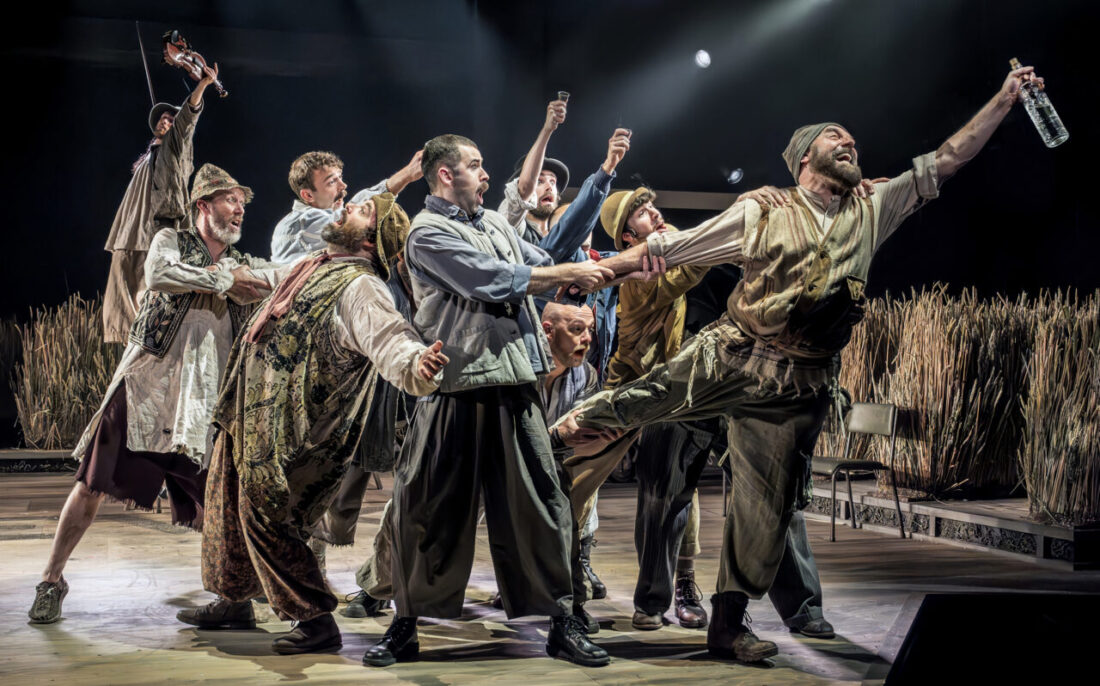
Tom Scutt’s Olivier-winning design has been tweaked and the results are breathtaking. The curved roof at the Park, which looked like a giant wheat-topped sod of ground peeled back to reveal the oppressed lives below, has been replaced by a solid slab that rises and falls throughout the show – at one point in a complete coup-de-theatre, four cast members hold stakes at each corner and the slabs sinks gently to form a giant canopy above a wedding scene, filling the entire stage.
Stage lights are always tricky at Regent’s Park, rarely registering early in the evening especially on gloriously sunny days but in the Barbican, Aideen Malone’s lighting design really shines, especially in the ‘Sabbath Prayer’ scene when the slab sinks again to become the low-hanging roof of the tiny humble home of Tevye and Milkman and his long suffering wife Golde, lit up and shining from below as bright as burnished gold. Just one of a series of arresting, ravishing scenes and tableaux conjured up on stage.
The cast are a complete dream, led from the front by Dannheisser’s Tevye, a poor milkman reduced to pulling his heavy cart because his horse is lame. A pragmatist who sees both sides of any argument, he keeps up a grumbling dialogue with God about his woes and quotes extensively (and dubiously) from ‘the good book’:
“Sometimes I think, when it gets too quiet up there, You say to Yourself, ‘What kind of mischief can I play on My friend Tevye?'”.
US stage and TV star Dannheisser, who played the butcher Lazar Wolf in a previous Broadway production, has a natural comedian’s ability to break the fourth wall and play direct to the audience, and has a beautiful chemistry with Laura Pulver (also Olivier nominated) as long suffering his wife of 25 years.
His headstrong daughters, Tzeitel, Chava and Hodel, who challenge his patriarchal authority by ignoring the traditional method of finding a husband using the gossiping matchmaker Yente (a supremely funny Beverley Klein), choosing instead a poor tailor (Dan Wolff), a penniless student radical (Daniel Krikler) and an orthodox Russian (Simon Anthony) as husbands against his express wishes, are given beautiful well rounded portrayals by Natasha Jules Bernard, Hannah Bristow, and Georgia Bruce.
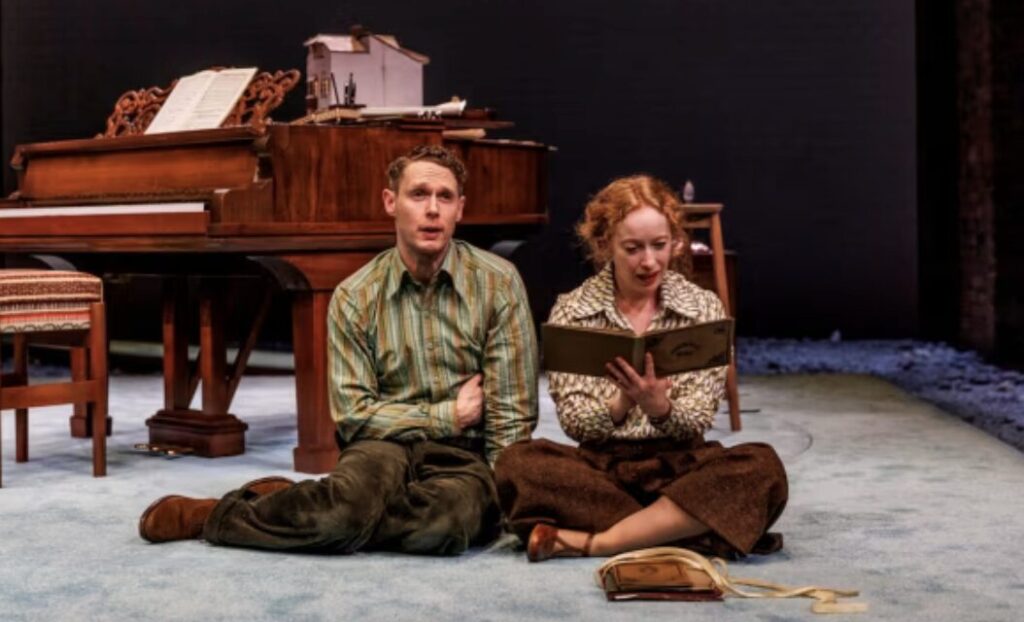
One person I really must single out is Mr Krikler as Perchik, the student from the university in Kiev, with modern religious, political and progressive ideas. You just can’t take your eyes off him whenever his is on stage. He is a bundle of hyperactive energy, his arms and legs always completing his verbal dialogue. And you can feel the sexual tension crackling in the air the first time he dares Hodel (Georgia Bruce) to dance with him, collapsing on the floor, his legs finally sliding easily around her torso. It is a beautiful, joy filled moment. One of many.
Special mention too for Raphael Papo (also Olivier nominated) as The Fiddler, He becomes a shadow or sounding board for Tevye and his mournful playing is both seductive and haunting.
If you saw Fiddler at Regent’s Park you really do need to see it again. It is a Fiddler for our time and all ages. This is the Must See Musical Event of the Summer. Miss it at your peril.